


For the past two decades, the Museum of Contemporary Art Detroit (MOCAD) has been an inspiring fixture on Woodward Avenue in Detroit’s vibrant Midtown neighborhood. Its stark dark frontage, featuring the glowing words “EVERYTHING IS GOING TO BE ALRIGHT,” is a feel-good affirmation to the community and all those who see it.
The building was originally a car dealership designed by famed Detroit architect Albert Kahn in the early 20th century and reimagined by architect Andrew Zago as a contemporary museum for MOCAD’s opening in 2006.
Led by co-directors Marie Madison-Patton and Jova Lynne, MOCAD is a lively non-collecting museum showcasing contemporary art that connects Detroit and the global art world. Non-collecting museums do not permanently own art or artifacts, as many traditional museums do, which allows such institutions the flexibility to quickly and intentionally adapt to societal and cultural changes, and focus on visitor experience and education.
Madison-Patton explains: “We’ve established ourselves as the only contemporary art museum in Detroit. We’re staying true to our mission and what’s most important in the community — to be open to all, to engage, and to be accessible.”
In celebration of MOCAD’s 20th anniversary, the museum recently reopened after closing for renovations to prepare for future decades. In addition to facility upgrades including a new roof and HVAC system, the building has been renovated internally for better flow and accessibility.
“We’ve also had a visual facade change, with the addition of windows. As you drive down Woodward you now have a window into the museum’s galleries,” Lynne notes.
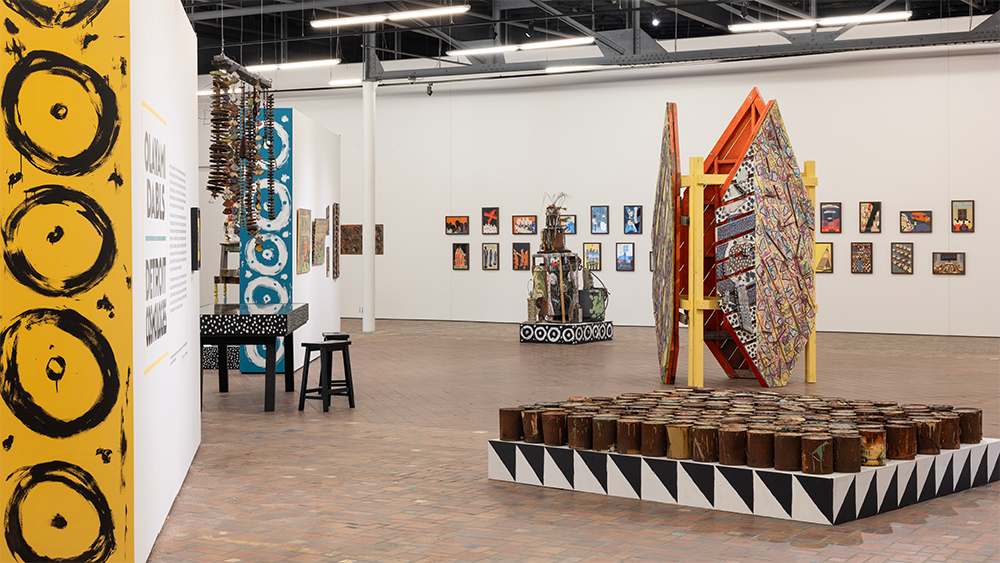
MOCAD’s milestone anniversary theme is Radical Imagination, Plural Futures, which showcases opening exhibitions from Olayami Dabls, Carole Harris, and Martha Mysko, Detroit-area artists who have helped shape the city’s creative and cultural landscape for decades.
Dabls’ exhibit, entitled Detroit Cosmologies, runs through mid-July and is the first comprehensive retrospective of his work spanning more than 45 years. His art utilizes ancient symbols and materials such as iron, rocks, wood, and mirrors, which he believes speak to all cultures universally.
According to Dabls, he has seven murals across the city and has created over 3,000 works of art. The artist, visual storyteller, and cultural historian is also the founder of Detroit’s iconic MBAD African Bead Museum and Dabls African Bead Gallery, which specialize in African-inspired art and beads.
“I’ve spent my life interested in history, particularly of African people. My art tells a story representative of someone in an African community, and my imagination became the subject,” he reflects. “We tend to forget how important the past is to us; it guides us to the present. It’s difficult to recreate the past, so I create images that represent the past, giving people a visual story.”
In addition to rotating exhibitions, the museum offers public programming to foster community engagement, such as artist-led talks and workshops, free programs for Detroit K-12 students, and Community Care health and wellness programming. A 20th anniversary gala is planned for October.
“MOCAD is a welcoming, inviting, accessible place that offers space for radical artmaking, experimentation, and civic engagement,” Lynne says.
According to the co-directors, as MOCAD moves into the future they’ve also been reflecting on its history and the solid foundation that was set by three dynamic women who helped found the institution: Marsha Miro, and the late Susanne Feld Hilberry and Julia Reyes Taubman. The museum building was recently dedicated to Taubman, who was active in Detroit’s art and design world and was known to work closely with artists.
“They believed in the possibility of contemporary art and artists, especially local artists. These roots reflect the promise of what’s possible and what we want for the museum for the next 20 years,” Madison-Patton explains. “We’re looking forward to doing this work and being a continued presence in the community.”
MORE INFORMATION: mocadetroit.org
|
|
|


 has been an inspiring fixture on Woodward Avenue in Detroit’s vibrant Midtown neighborhood.)